Pfarrkirche Sallingstadt
Templom
Leírás
Information about the church
The name Sallingstadt is presumably a wishful name that denotes a place where people can live "blissfully", i.e. without wishful thinking. The first documentary mention of Sallingstadt as Seligenstat (referring to a place, not a town) dates back to December 21, 1268.
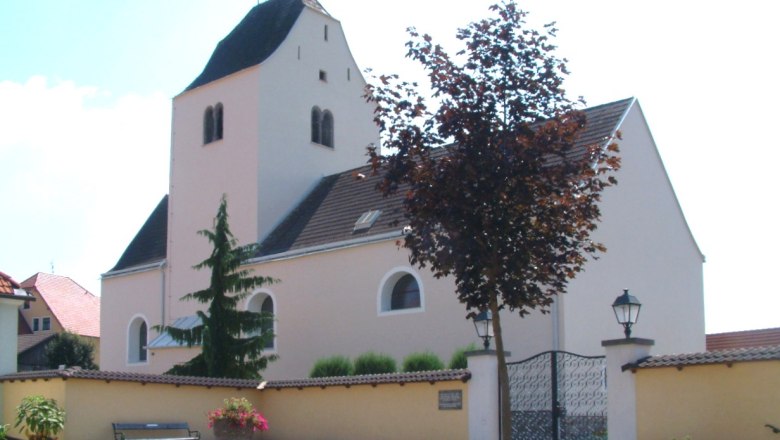
The Roman Catholic parish church of Sallingstadt stands on the southern edge of Sallingstadt's Angers and is dedicated to St. Martin of Tours.
The Romanesque east tower church from the 13th century adjoins an older Romanesque chapel. The late Gothic reconstruction took place after a fire in 1427 in the middle of the 15th century.
The exterior of the church features a nave from the end of the 13th century with a simple, smooth gable front and Baroque arched windows from 1685. To the east is the massive rectangular tower, also from the end of the 13th century, under a crested hipped roof with four domed arched windows with leaf capitals. To the east of the tower, the rectangular choir stands in the same width under a gabled roof, as a former 12th century chapel, to the east with a walled Romanesque window in a funnel reveal and to the north and south with a Baroque arched window. The low sacristy extension from the 15th century stands to the south of the tower under a lean-to roof.
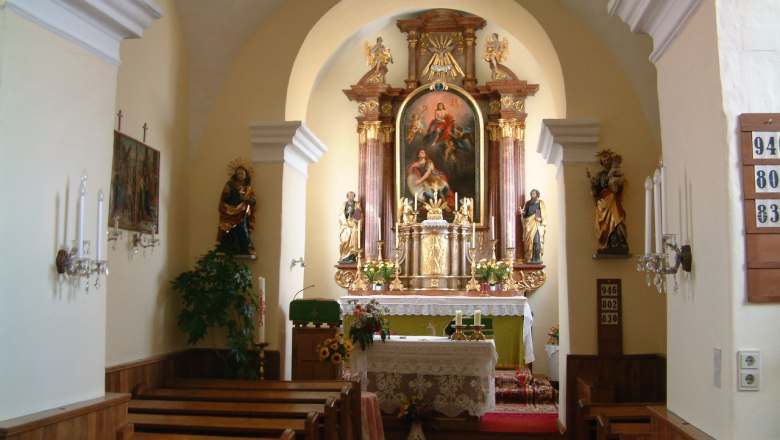
The interior of the church has a two-aisled, four-bay nave with a ribbed vault on eight-sided pillars. The two-arched west gallery is cross-vaulted, the painting on the parapet shows fragments of a row of apostles from the mid-15th century. The tower storey has a groined vault from the 13th century. The slightly raised choir has a baroque groined vault from 1686. The late Gothic sacristy has two bays with a barrel vault and a dividing ribbed vault.
The parish was founded in the middle of the 14th century. A parish priest is mentioned in documents in 1398. From the middle of the 17th century until 1783, the church was a branch of the parish church of Großglobnitz; the re-established parish was incorporated into Zwettl Abbey.
Treat yourself
St. Martin of Tours, patron saint of the parish church in Sallingstadt, is one of the best-known and most popular saints in Christian tradition. His story, in particular the famous tale of the sharing of his cloak, embodies values such as charity, modesty and selflessness.
The life of St. Martin
The best-known legend of St. Martin tells how, as a young soldier, he saw a freezing beggar on a cold winter's day. Martin did not hesitate to draw his sword and cut his soldier's cloak in half. He gave one half to the beggar to protect him from the cold and kept the other half for himself. The following night, Christ appeared to him in a dream, dressed in the half of the cloak that Martin had given to the beggar, and said: "Whatever you did for one of the least of these brothers of mine, you did for me."
"Treat yourself"
"Treat yourself" means giving yourself time and space for inner growth, self-care and reflection. St. Martin teaches us through his example that true self-care also includes how we treat others. The act of sharing his coat shows that in selflessness and charity lies a deep form of self-respect and self-realization. Martin kept part of his cloak for himself, which is symbolic of the fact that we must also protect and respect ourselves while being there for others.
Conclusion
St. Martin and the story of the sharing of the cloak teach us that "treat yourself" is not just about pampering yourself or resting, but also about growing in charity. It reminds us that giving and sharing is a form of self-care that enriches and strengthens our own souls. It is in the balance between caring for ourselves and others that we find the true meaning of inner peace and fulfillment.
"Love your neighbor as yourself." (Matthew 22:39)
This biblical passage emphasizes the balance between self-love and love for others. St. Martin shows us that these two aspects go hand in hand: By caring for others, we are also looking out for our own salvation and well-being.